
🍄 Into the Woods: A Detour for Mushrooms
The van turned off the main road and onto a narrow dirt path flanked by pine and birch trees. The hum of tires on gravel changed the rhythm of the journey—quieter, slower, as if the forest itself had asked them to lower their voices.

“Is this where we’re stopping?” Julia asked, looking out the window at the mossy ground and tall, slender trees.
Tomas nodded. “I came here last autumn. It’s usually good for mushrooms, especially if it rained a few days ago.”
Renata, already tying her scarf, smiled. “This is exactly the kind of stop I love. Not planned, but full of possibilities.”
They parked under the partial shade of a birch grove. The air was damp and filled with the scent of needles and wet earth. Far from any town, the place was quiet enough that you could hear birds fluttering between branches and the soft creak of the trees in the breeze.
Julia crouched to inspect a patch of moss. “This feels almost unreal.”
Emma picked up a woven basket from the van. “Let’s not waste the mood. Renata, what are we looking for?”
“Chanterelles if we’re lucky, but I’d be happy with some slippery jacks or even puffballs. Just don’t touch anything with gills unless you’re sure.” She laughed. “And no red caps.”
🍄 走進森林:為香菇而繞道
休旅車轉出主幹道,駛入一條狹窄的土路。兩旁是高大的松樹與白樺,車輪在碎石上的聲音讓整趟旅程的節奏慢了下來——彷彿森林本身在提醒他們:安靜點,輕一點。
「我們是要在這裡停嗎?」Julia 探頭望著窗外苔蘚覆地的林間。
Tomas 點了點頭。「我去年秋天來過。只要幾天前有下過雨,這一帶通常會有香菇。」
Renata 已經繫上頭巾,笑了笑:「我最喜歡這種沒有預定、卻很有機會發現驚喜的停留了。」
他們將車停在一片白樺林的邊緣。空氣潮濕,混著松針與濕土的氣息。遠離市區,這裡安靜到能聽見枝葉間鳥兒振翅的聲音,還有微風吹過林梢的細語。
Julia 蹲下來觀察一片青苔。「這裡的感覺好不真實。」
Emma 拿出放在車上的編織籃子。「既然氣氛正好,那我們就別浪費了。Renata,我們要找什麼?」

「如果運氣好會有雞油菌,不然也許有牛肝菌、松乳菇,甚至 puffballs 也可以。」她笑著說:「有鰓的先別碰,還有那種紅帽子的……一律跳過。」
🍄 A Forest Detour
After finishing their coffee and stretching a little under the mid-morning sun, the group climbed back into the van and resumed their journey south. The road curved gently between rolling hills, patches of pine forest flickering past the windows like slow-motion waves.
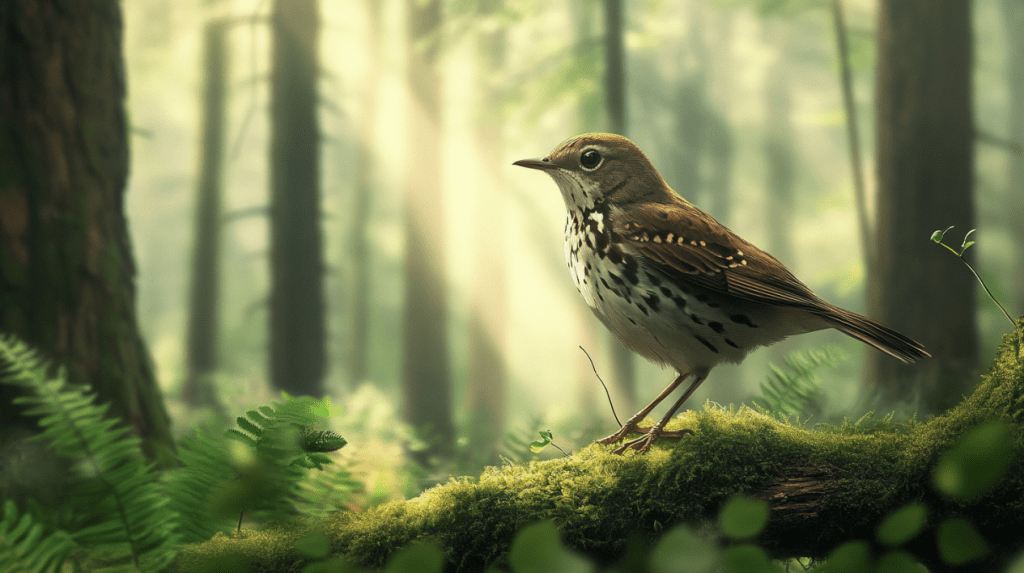
Tomas adjusted the volume on the radio—it was playing something soft, instrumental. “There’s a forest trail about fifteen minutes off the main road,” he said. “I remember there were mushrooms last year around this time. Want to try our luck?”
Renata looked up from her notes and smiled. “If we see chanterelles or birch boletes, that alone makes the stop worth it.”
The others agreed easily. With no strict timeline, they welcomed the spontaneous detour.
The side road narrowed quickly, flanked by birches and alder trees. A wooden sign marked the trailhead, barely visible behind some tall grass. Tomas parked the van beside a meadow buzzing with bees.
As they stepped into the forest, the air changed. It was cooler, fragrant with damp leaves and pine. Birds chirped unseen in the canopy above. Julia instinctively took out her camera. Emma, notebook in hand, paused to sketch a peculiar-looking fern.
They spread out slowly. The undergrowth wasn’t too thick, and sunlight filtered in gentle patches. Renata crouched near a mossy stump, inspecting a patch of mushrooms. “These aren’t edible, but look at the structure. Beautiful, aren’t they?”
Ben, holding a small field guide, added, “I read somewhere that this region’s soil is unusually sandy. That’s why you get certain fungi here that don’t appear farther north.”
“Also explains the pine-dominated forest,” Tomas noted, glancing up.
They didn’t speak much—there was something about a forest that quieted people in the right way. An hour passed like water. By the time they returned to the van, they had collected a few safe mushrooms, some photos, and the kind of gentle contentment that doesn’t need to be spoken.
森林中的小插曲
喝完咖啡、在陽光下伸了個懶腰後,大家再次回到車上,繼續南行的旅程。道路在起伏的丘陵間緩緩延伸,兩側不時掠過一片片松林,如同慢動作的波浪從車窗外滑過。
Tomas 稍微轉小了廣播的音量,播著一段柔和的器樂曲。「主幹道旁大概十五分鐘有條小徑,」他說,「我記得去年這個時候,那邊有不少香菇。要不要繞去看看?」
Renata 從她的筆記抬起頭,笑了笑:「如果能看到雞油菌或白樺牛肝菌,那就值得停一下了。」

其他人也都欣然同意。這趟旅程沒有硬性的時間表,反而讓這種臨時決定增添了一絲冒險感。
岔路很快變窄,兩旁是白樺與榿木林。路邊一塊木製指標藏在高草之後,幾乎看不見。Tomas 把車停在一處開滿野花的草地旁,蜜蜂在空中嗡嗡作響。
踏入林中,空氣一下子變涼了,濕潤的落葉與松針的氣味撲面而來。頭頂的樹冠間傳來鳥鳴聲,但看不見牠們的身影。Julia 下意識地拿出相機,Emma 則停下來,拿出筆記本畫下一株形狀奇特的蕨類。

他們慢慢地散開。林下植物不算密,陽光斑駁地灑在地面。Renata 蹲在一個長滿青苔的樹樁旁,仔細觀察一片香菇。「這些不能吃,但你們看那結構,多美。」
Ben 拿著一本野外植物手冊說:「我看過資料,這一帶的土壤偏沙質,所以會長一些北方見不到的菌類。」
「也難怪這裡大多是松林,」Tomas 抬頭應和著。
他們之間沒說太多話——森林自然地讓人安靜下來,一種恰到好處的沉默。一個小時悄悄溜走。當他們回到車上時,手裡有些可食用的香菇、幾張照片,還有那種不需要言語的平靜滿足。
Forest Stillness and the Next Journey
As they left the forest, the sun had climbed higher in the sky. The car bumped gently along the gravel road, windows down, letting in the crisp scent of pine needles.
Renata checked the mushrooms in the cloth bag and said, “We should find a place to rest. My stomach’s starting to complain."
Tomas glanced at the GPS. “There’s a small village about ten kilometers ahead. There’s a café—should be good enough for a simple lunch."
“Sounds perfect," Ben smiled and leaned back in his seat.
They didn’t talk much on this stretch of road, simply letting the endless pines and blue sky drift past the windows. The forest stayed with them, a soft lingering glow.
林間餘韻與新的旅程
離開森林時,陽光已爬得更高了。車子在碎石小路上輕輕顛簸著,車窗開著,帶進來一股乾爽的松針香。
Renata一邊檢查著放在布袋裡的香菇,一邊說:「我們應該找個地方休息一下。肚子開始抗議了。」
Tomas打開導航看了看:「前面十公里左右,有個小村莊。有家咖啡館,應該可以吃點簡單的午餐。」
「聽起來很完美,」Ben微笑著,靠回座椅。
這一段路,他們沒多說話,只是靜靜地感受車窗外滑過的松林與藍天。森林留在他們心裡,像一層柔軟的光。

Lunch in the Small Village
The car rolled slowly into the village.
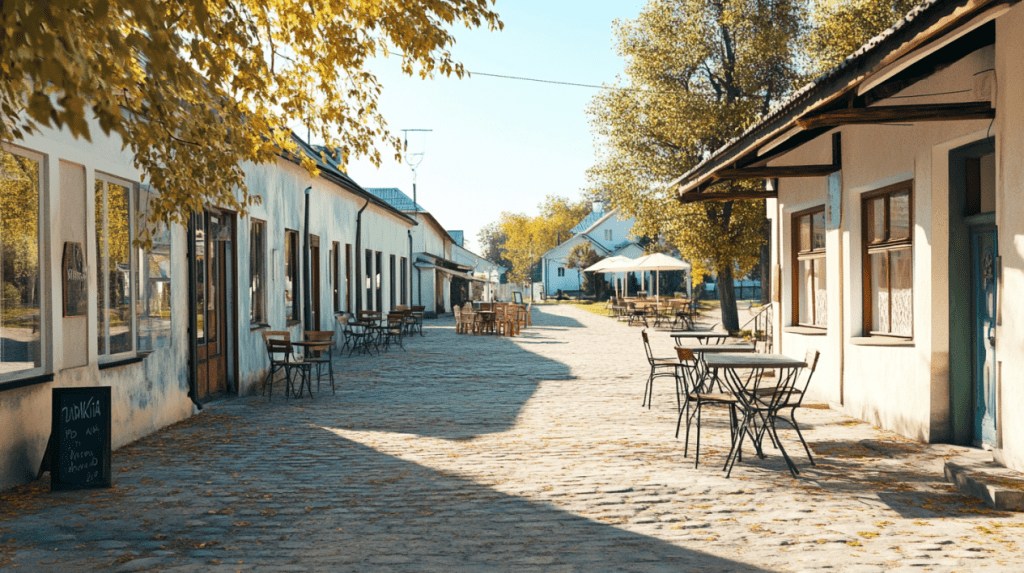
There were only a few streets, and at the center of a tiny square stood an old stone well. The café nearby was small and humble, with a few tables set outside. Its whitewashed walls had a slight, sun-faded tint, hinting at its age.

They chose a seat by the window. Dried flowers and handmade woven decorations hung from the walls, and the air smelled of coffee and freshly baked bread.
“This place is lovely," Emma said softly.
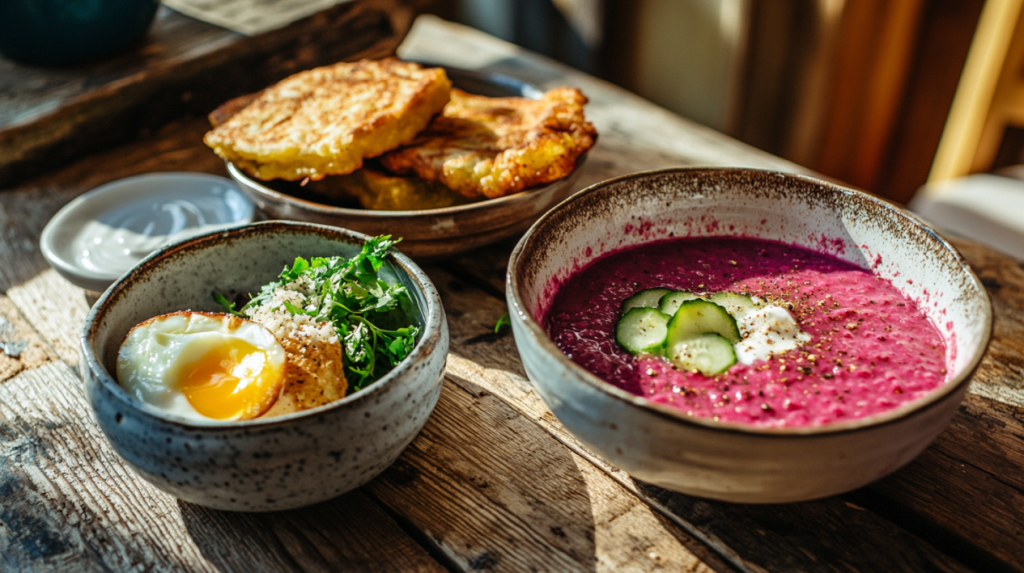
The menu was simple and comforting: cold beet soup (Šaltibarščiai), potato pancakes (Bulviniai blynai), and the beloved Lithuanian fried rye bread (Kepta duona) with a side of garlic butter.
Tomas ordered a bowl of bright pink cold soup, with bits of beetroot and cucumber floating inside, served alongside a steaming plate of potato pancakes.
Renata smiled and asked for the fried bread, dipping it into the garlic sauce. “This," she said, “is one of the most nostalgic flavors for Lithuanians."

Ben casually took a photo of the table. “Whenever I see this picture later, I’ll remember today’s sunlight and this stretch of the journey."
They ate slowly, letting the stillness from the forest seep into each bite.
小村莊的午餐
車子緩緩駛進村莊。這裡只有幾條街,小小的廣場中央有一座舊石製水井,一旁的咖啡館低矮樸素,門口擺著幾張桌椅。白色牆面在陽光下有些微微泛黃,看得出年代。

他們選了靠窗的位置坐下。牆上掛著乾燥花和手工編織的小掛飾,空氣中混著咖啡與烘焙麵包的香氣。
「這地方太可愛了,」Emma輕聲說。
菜單簡單又溫暖:有冷湯(Šaltibarščiai)、馬鈴薯煎餅(Bulviniai blynai)、還有立陶宛常見的鄉村烤麵包(Kepta duona),佐著蒜味奶油醬。
Tomas點了碗鮮粉紅色的冷湯,裡頭漂著切細的甜菜與小黃瓜,還配著一盤熱呼呼的馬鈴薯煎餅。
Renata笑著要了一份烤麵包,邊蘸著蒜醬邊說:「這個,是立陶宛人最懷念的味道之一。」
Ben拿出相機,隨手拍了一張食物的照片。「以後看到這張,就會記得今天的陽光跟這段路。」
午餐吃得不急不緩,像是把森林帶來的安靜,慢慢滲進每一個味蕾。
Dzūkija National Park Wetland
After lunch, they set off again, the car humming softly along the quiet country roads. The village soon fell behind them, and the landscape grew wilder.
The trees became denser, taller, with pines dominating the horizon. Occasionally, they crossed narrow streams, the water glinting under the afternoon sun.
About twenty minutes into the drive, Tomas slowed the car as they approached a small wooden platform by the side of the road.
“Look," he said, pointing, “there’s a wetland over there."
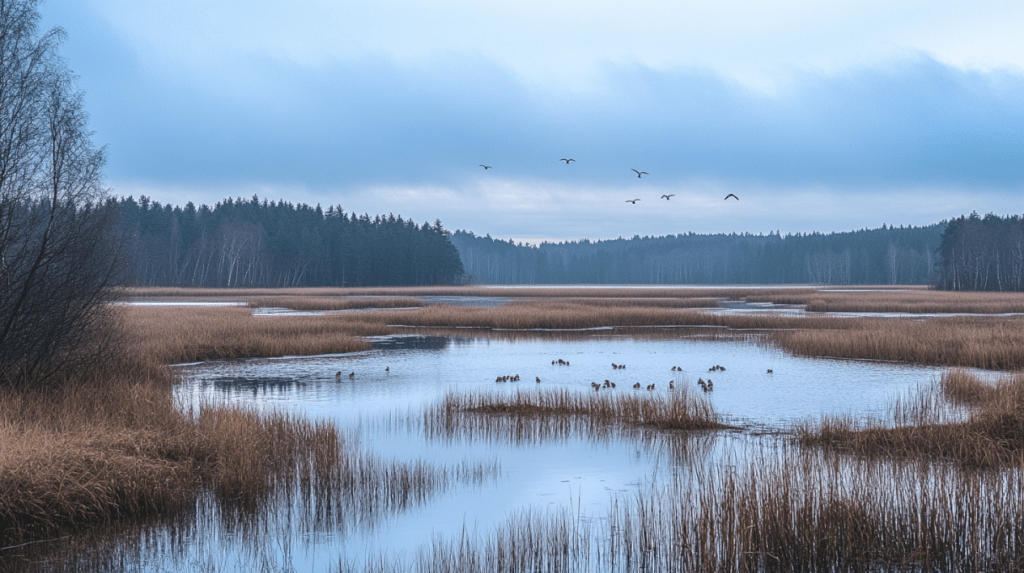
They got out and walked to the platform. From there, a wide stretch of wetland opened before them, shimmering with patches of shallow water and tufts of reeds. The land was flat and open, the sky immense above it.
Renata leaned on the wooden railing, her eyes scanning the water’s edge. “You see those small yellow flowers? That’s marsh marigold. It blooms early in wetlands like this."
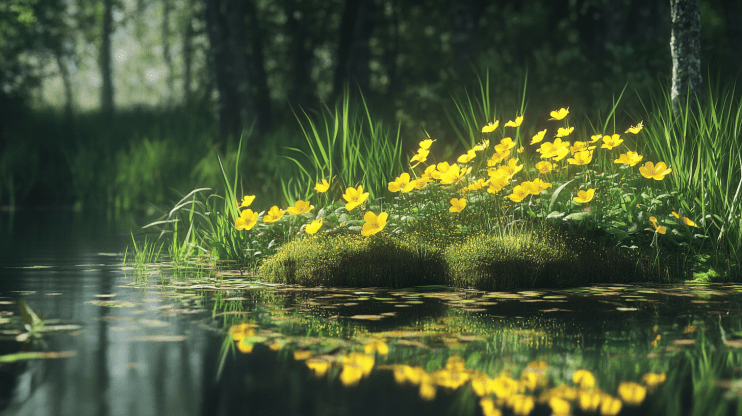
Ben took out his camera, adjusting the lens. “And the birds—are those storks?"
“Some are," Tomas said. “But you’ll also see herons here, and sometimes cranes if you’re lucky."

A Crane in the Wetland ( 濕地的鶴)
The air smelled slightly of damp earth and pine resin. It was quiet except for the distant calls of birds and the gentle rustling of the reeds.
They stayed a while, letting the landscape sink in—open, breathing, full of slow, patient life.
Dzūkija 的溼地
午餐後,他們重新出發,車子在安靜的鄉間小路上輕輕滑行。村莊很快消失在身後,沿途的風景變得更加原始。
樹木逐漸高大茂密,松樹成了地平線上的主角。偶爾,細小的溪流在午後陽光下閃著光芒,穿過道路。
大約開了二十分鐘,Tomas慢下了車速,在路邊的一個小木製觀景台旁停了下來。
「看,」他指著前方說,「那邊有片濕地。」

他們下車,走到觀景台。從這裡望出去,一大片濕地在陽光下閃爍著水光,稀稀落落長著蘆葦與草叢。土地平坦開闊,天空顯得格外遼遠。
Renata靠在木製欄杆上,細細觀察著水邊的植物。「你們看到那邊那些小黃花嗎?那是沼澤金盞花,在這種濕地裡很早就開花了。」
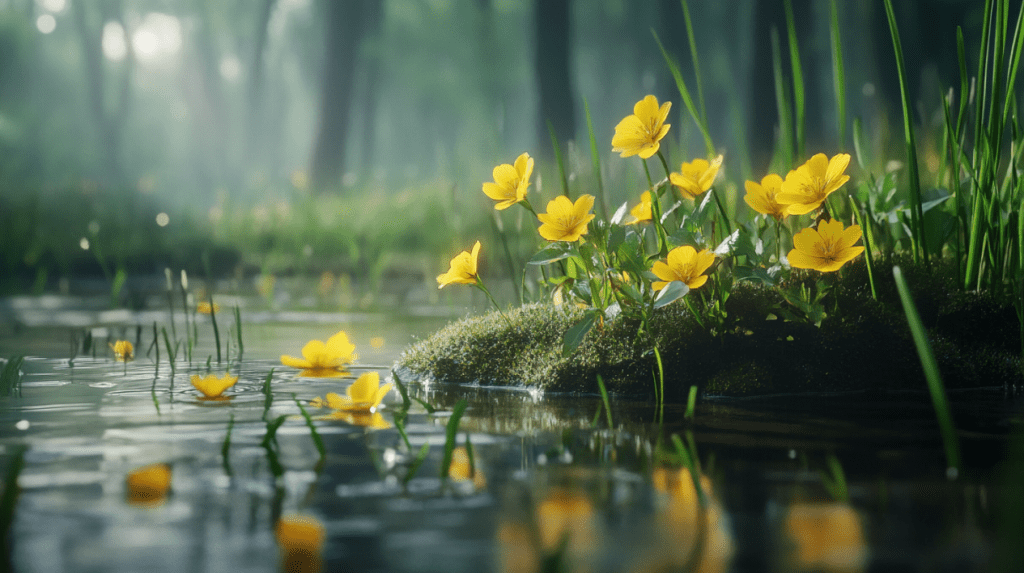
Ben拿出相機,調整鏡頭對準遠方。「那邊的鳥是鸛嗎?」
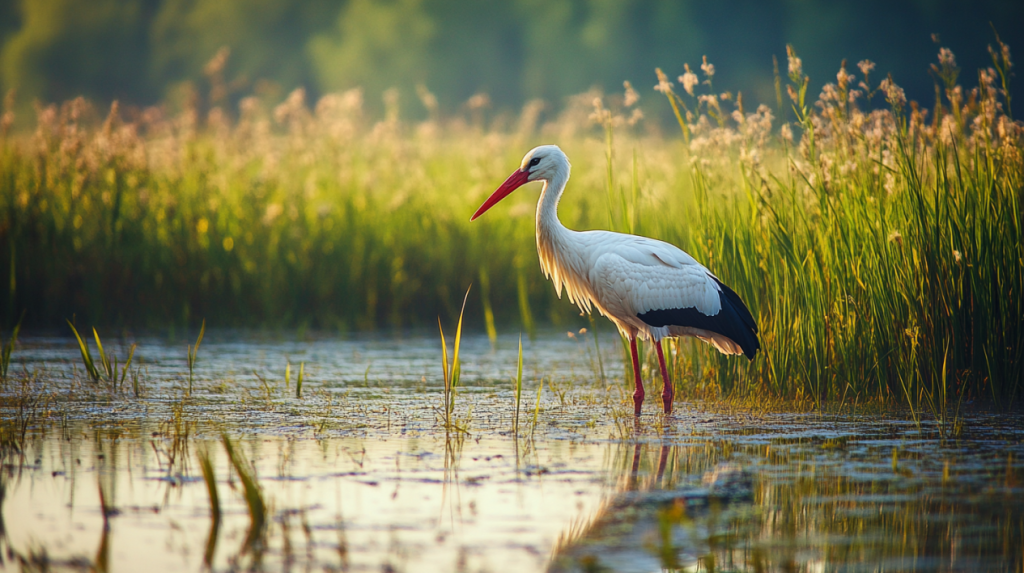
白鸛 (white stork)
「有些是,」Tomas回答。「這裡也能看到蒼鷺,有時運氣好,還能看到鶴。」
空氣中帶著微微的濕潤泥土味與松脂香氣。除了遠處鳥叫聲與蘆葦輕輕搖曳的聲音,四周一片寧靜。
他們在觀景台上靜靜停留了一會兒,任由這片廣闊、緩慢而有生命力的景色,慢慢滲進心底。
Wetland Birds
Ben adjusted his focus, following a white bird gliding low over the marshy water. “I wonder," he said, not taking his eyes off it, “do they actually live here all year, or are they just…passing through?"
Tomas leaned against the railing, watching the slow movements across the wetlands. “Some do stay," he said. “Especially mallards and a few resident herons. But most of what we see right now — the storks, the cranes — they’re seasonal visitors. They come to breed in spring and summer."
Renata brushed a stray strand of hair from her face as the breeze picked up. “Dzūkija is part of the East Atlantic Flyway. It’s one of the major migration routes in Europe. In autumn, you’ll see enormous flocks gathering here — sometimes thousands of birds resting before continuing south."
Emma rested her arms on the railing, staring at the distant shimmer of wings. “Thousands," she repeated softly. “Where do they go for the winter? How far?"

“Many fly all the way to Africa," Tomas said. “Some just to southern Europe — Spain, Italy, Greece. It depends on the species. But the ones going to Africa cross the Mediterranean, and some even reach the Sahel."
Ben whistled under his breath. “That’s… insane. From here, all the way across continents. I can’t even imagine making that kind of journey."
Renata smiled. “And they do it twice a year. North in spring, south in autumn. They follow the seasons, like an invisible thread ties them to distant lands."
The wetland, which a moment ago seemed so peaceful and local, now felt vast — connected to deserts, forests, and oceans far beyond what they could see.
濕地的鳥類
Ben調整著鏡頭,跟隨著一隻白色的鳥兒低飛掠過濕地的水面。「我在想,」他目不轉睛地說,「牠們真的常年住在這裡嗎?還是……只是經過?」
Tomas靠在欄杆上,看著濕地上緩慢流動的光影。「有一些是常駐的,」他說。「像是綠頭鴨,還有少數幾種留鳥的蒼鷺。但你們現在看到的,大部分像鸛、鶴這類,都是季節性的訪客。牠們春天來這裡築巢繁殖。」
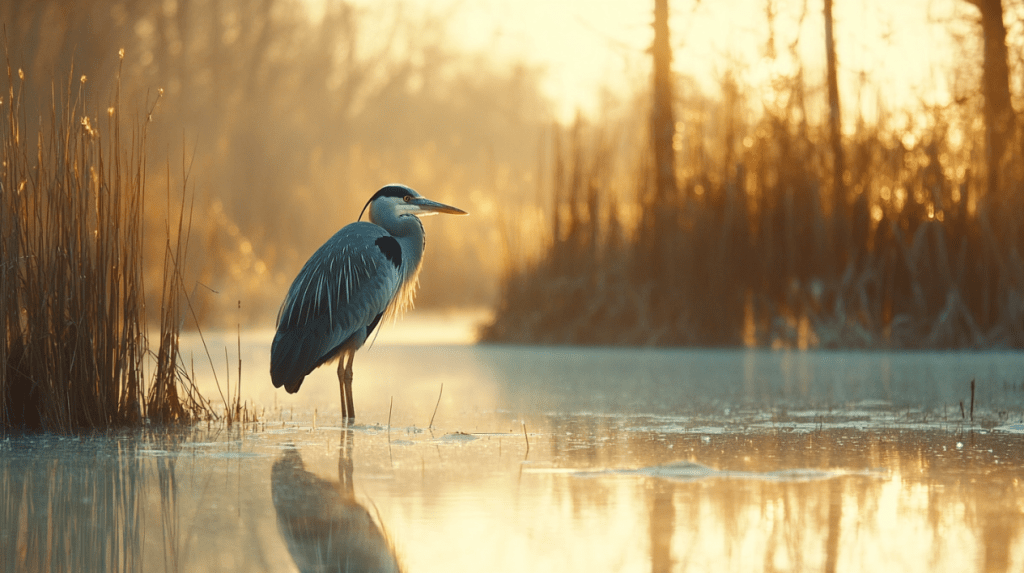
蒼鷺 (heron)
Renata在微風中撥了撥臉頰邊的一縷頭髮。「Dzūkija 位在東大西洋遷徙路線上,是歐洲主要的遷徙通道之一。到了秋天,這裡會聚集成千上萬的鳥群——有時滿天都是,牠們在出發前暫停休息。」
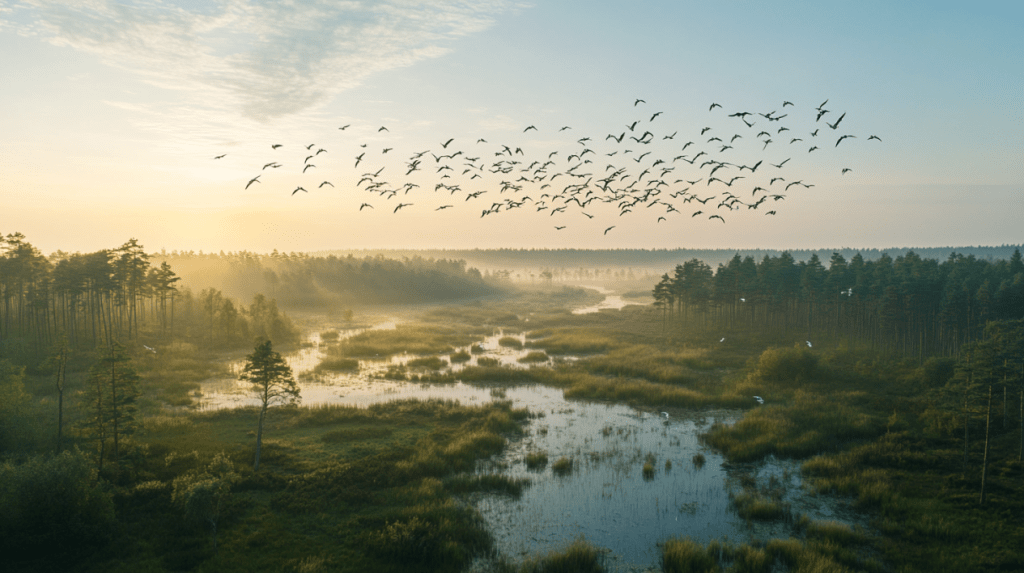
Emma將手肘靠在欄杆上,靜靜望著遠方閃爍的翅膀。「成千上萬,」她低聲重複了一遍。「那牠們冬天要飛到哪裡?要飛多遠?」
「很多飛到非洲,」Tomas說。「有些只飛到南歐,比如西班牙、義大利、希臘。但若是要飛往非洲的,就得跨越地中海,有些還會飛到薩赫勒地區。」
Ben小小地吹了聲口哨。「真是難以想像。從這裡,一路飛越幾千公里,跨洲旅行……」
Renata輕輕笑了笑。「而且每年來回兩次。春天北上,秋天南下。就像季節之間,有條看不見的細線,把牠們牽引到遙遠的地方。」
眼前這片濕地,剛才還只是靜靜的一片地方,這一刻突然變得遼闊了起來——彷彿透過這些飛鳥,與遠方的沙漠、森林、海洋都連接在了一起。
Ecological Research
Ben lowered his camera for a moment. “Tomas, didn’t you say you teach at Vilnius University? Is your department connected to places like this?"
Tomas smiled, resting his arms on the railing. “Yes. I’m with the Faculty of Natural Sciences, in the Biosciences Institute. We do quite a lot of work related to ecology and environmental studies."
He gestured toward the wetland stretching out before them. “Actually, areas like this are very important for our research. Some of our teams monitor wetland biodiversity — birds, amphibians, aquatic plants. Wetlands are delicate systems, very sensitive to climate and human activity."
Renata leaned on the railing and asked, “Do you or your students actually come here to do research?"
Tomas nodded. “Yes, a few times a year. We have monitoring projects in several wetlands in Dzūkija. Mostly bird population counts, water quality sampling, and vegetation surveys."
Ben looked interested. “Do you track changes over time?"
“Exactly," Tomas said. “We compare data season by season. Changes in bird species, shifts in plant coverage, even slight differences in water chemistry — it all tells us how the ecosystem is doing."
Emma glanced at the wide stretch of wetland. “So when you come here, it’s not just sightseeing."
Tomas smiled. “No, it’s a lot of early mornings, muddy boots, and long hours with binoculars and field notebooks."
大學的生態研究
Ben暫時放下了相機。「Tomas,你不是說你在維爾紐斯大學教書嗎?你們那個系跟這種地方有關嗎?」
Tomas笑了笑,雙手靠在欄杆上。「對,我在自然科學學院的生物科學研究所,主要做生態學和環境研究相關的教學和項目。」
他朝著眼前的濕地輕輕一指。「其實,像這樣的地方對我們研究來說非常重要。我們有些團隊專門在監測濕地生物多樣性——鳥類、兩棲類、濕地植物。這些生態系統非常脆弱,對氣候變化和人類活動特別敏感。」
Renata靠著欄杆問:「你們真的會來這裡做研究嗎?學生也有參與?」
Tomas點點頭。「會啊,每年來好幾次。我們在Dzūkija的幾個濕地都有監測計畫。主要是鳥類族群調查、水質取樣,還有植被變化的記錄。」
Ben露出興趣的表情:「那你們會追蹤變化嗎?」
「沒錯,」Tomas說。「我們會一季一季比較資料。像是鳥種的變化、植物覆蓋範圍的變動,甚至是水質化學成分的微小差異——都能反映這個生態系的狀態。」
Emma望向那片廣闊的濕地。「所以你們來,不是只是看看風景而已吧?」
Tomas笑了笑:「當然不是。通常是天還沒亮就出門,穿著泥巴滿身的靴子,拿著望遠鏡和田野筆記本待上一整天。」

 Virtual Travel | 虛擬旅行沉浸式英語學習
回覆給The Virtual World Explorer 取消回覆